

Port Phillip Matters
Council Unanimously Rejects Fast-Tracked Hotel as Community Fights Permanent Planning Takeover
Author: Rod (St Kilda Resident)
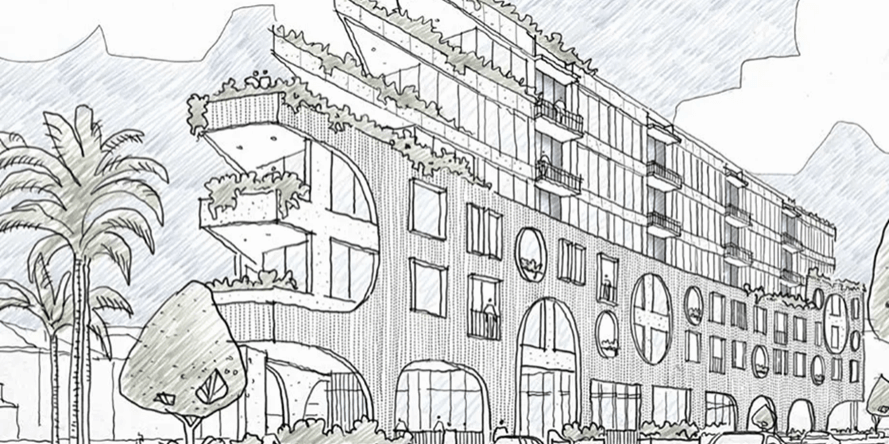
A proposed 7-storey hotel in one of Melbourne’s most significant heritage precincts has been unanimously opposed by the City of Port Phillip — but under the Allan government’s Development Facilitation Program, the Minister for Planning alone decides its fate.
St Kilda Hill Heritage Community — May 2026
On the night of 6 May 2026, every one of the nine elected councillors of the City of Port Phillip voted to formally oppose a proposed hotel development at the corner of Carlisle and Havelock Streets in St Kilda. The vote was unanimous — 9 to 0. Not a single abstention. Yet under the Victorian government’s Development Facilitation Program, that unanimous democratic verdict carries no binding weight. The Minister for Planning alone decides.
The proposed development — a 7-storey, 204-room residential hotel with a rooftop bar, two levels of basement parking and function rooms at 2-8 Carlisle Street, 3 Albert Street and 3-9 Havelock Street, St Kilda — is being assessed under Clause 53.22 of the Victoria Planning Provisions, a mechanism introduced by the Allan government in September 2023 to fast-track projects of ‘significant economic development.’ Under this pathway, the City of Port Phillip has no decision-making role, and affected residents have no right of appeal to the Victorian Civil and Administrative Tribunal. The Minister is the sole decision-maker.
A HERITAGE PRECINCT UNDER PRESSURE
The site sits within Heritage Overlay 5 — the St Kilda Hill precinct — one of Melbourne’s most significant Victorian-era heritage streetscapes, characterised by 19th century cottages, terraces and low-scale residential buildings. Two of those heritage cottages, built in the 1880s and located at 5 and 9 Havelock Street, sit within the development site itself. The proposal involves removing them from their foundations, trucking them off-site for storage, and reinstating them at a higher level once basement construction is complete.
The building, at 27 metres in height, would overtop two State-registered Victorian Heritage Register landmarks — Luna Park (VHR H0938) and the Palais Theatre (VHR H0947) — both icons of the St Kilda foreshore. It would bring hotel rooms, function facilities and an 872-square-metre rooftop bar and terrace complex to a streetscape that currently stands at three to five storeys.
The community has been here before. In 2009, the same developer applied to redevelop the Cosmopolitan Hotel site. Council imposed conditions capping the building at 6 storeys on Carlisle Street and 3 storeys on Havelock Street. The developer appealed to VCAT in 2010. VCAT upheld the 6-storey maximum. The developer extended the permit three times, then allowed it to expire in 2018 after Council refused a fourth extension. The 2026 application now seeks 7 storeys — one more than VCAT allowed — through a pathway specifically designed to bypass the tribunal entirely.
WHAT THE DEVELOPMENT FACILITATION PROGRAM DOES
The Development Facilitation Program was created in October 2020 as a COVID economic stimulus measure. In September 2023, the Allan government expanded it through Amendment VC242, introducing Clause 53.22 for ‘Significant Economic Development’ and Clause 53.23 for significant residential development with affordable housing.
Under Clause 53.22, a developer whose project meets a minimum cost threshold — just $10 million for a residential hotel in metropolitan Melbourne — can bypass the local council entirely. The Minister for Planning becomes the responsible authority. There are no third-party appeal rights. The community’s only opportunity for input is a public submission window, after which the Minister decides alone.
Professor Michael Buxton, Emeritus Professor of Planning at RMIT University, has described the DFP as ‘an assault on planning in the public interest,’ noting that the government ‘basically stripped away all the planning rules’ and introduced the changes ‘overnight’ without community consultation. A recent Herald Sun investigation confirmed that 183 out of 265 DFP applications have been approved — a 69 per cent approval rate.
THE PERMANENT WINDFALL CONCERN
At the heart of the community’s concern is not merely the height of the building, but the nature of the planning mechanism being used. The application combines a planning permit with a permanent planning scheme amendment, creating a new General Residential Zone Schedule 14 (GRZ14) specifically for this site.
Council’s own planning officers identified a critical flaw in this approach: GRZ14, once gazetted, removes the mandatory garden area requirement from this land permanently — regardless of whether the development is ever built. If the permit lapses, or is never acted upon, the planning uplift remains. The land becomes more valuable on the open market. There is no reversion mechanism, no sunset clause, and no requirement to deliver any public benefit — no affordable housing, no green space, no community infrastructure — in return.
Council’s officers formally recommended that a Specific Controls Overlay would be a more appropriate mechanism, as it would tie any zone change to a specific development outcome, preventing this permanent windfall effect. That recommendation was unanimously adopted by all nine councillors on 6 May 2026.
WHAT COUNCIL FORMALLY FOUND
The City of Port Phillip’s planning officer report, considered at the 6 May 2026 council meeting, identified the following key grounds of objection:
- The proposed scale does not adequately respond to the heritage residential context, fails to limit overshadowing of Carlisle Street outdoor dining areas, and fails to provide sufficient setbacks near neighbouring residential properties.
- A drainage easement at 9 Havelock Street is encumbered by a Section 173 Agreement in favour of Council. The proposed development encroaches into this easement at two basement levels and through the ground floor. The agreement must be formally resolved before any permit can legally issue — and no application has been made to do so.
- The views of the Office of the Victorian Government Architect have not been provided, and it is unclear whether concerns raised at the Victorian Design Review Panel in December 2022 have been addressed.
- The urban design and architecture fail to achieve the standard of design excellence that Clause 53.22 itself requires to justify departing from the current height and setback controls that would ordinarily apply to the site.
Should the Minister be minded to approve the application despite these objections, Council formally recommends that one storey be removed, bringing the building from 7 to 6 storeys — consistent with the maximum VCAT imposed on the same site in 2010.
A COMMUNITY THAT MOBILISED
The St Kilda Hill Heritage Community was formed in response to this application. In the first week after the public submission period opened in March 2026, over 1,000 residents and supporters signed a petition opposing the development. An 18-ground joint community submission was lodged on 8 April 2026 via the Engage Victoria portal. The petition remains open and can be signed at: https://c.org/pyYWww4Kyd
The community has received support across party lines. The Liberal Shadow Minister for Planning, David Southwick MP, has written directly to the Minister for Planning raising the community’s concerns. Labor MPs Nina Taylor and Ryan Batchelor MLC have engaged with the campaign. Greens candidate for Macnamara Sonya Semmens has confirmed her support. Independent representatives have also provided backing.
The campaign has been covered by The Age and the Herald Sun, and has connected with community groups in Windsor, Prahran, Brunswick and Dingley Village who are fighting similar DFP applications across metropolitan Melbourne.
WHAT HAPPENS NEXT
The Minister for Planning, Sonya Kilkenny, will now consider the application, the community submissions, and the Council’s formal objection. She may decide to approve the application, refuse it, impose conditions, or refer it to a Priority Projects Standing Advisory Committee for further consideration.
The City of Port Phillip has pre-authorised its statutory planning team to appear and advocate at any advisory committee proceedings. The community has stated it will pursue all available avenues, including the Victorian Ombudsman and the Legislative Council’s Environment and Planning Committee, if the application is approved without addressing the fundamental concerns raised by Council’s own officers.
The community’s position has not changed since the campaign began: it supports a thoughtful hotel development on this site, with a five-storey hotel on Carlisle Street and up to three storeys in the residential areas. What it opposes is the permanent, irrevocable rezoning of a heritage residential precinct through a mechanism that removes community rights, bypasses elected local government and delivers a windfall to a private developer regardless of whether a single brick is ever laid.
St Kilda Hill Heritage Community — stkildahillheritage@gmail.com — Sign our petition: https://c.org/pyYWww4Kyd — May 2026
Port Phillip Matters
Our local Port Phillip Matters newspaper keeps you up to date on community sports, school events, local personalities, local pets, with real community spirit.
Recent Comments