

Port Phillip Matters
COMMON SENSE WON
Author: Claire (St Kilda resident)
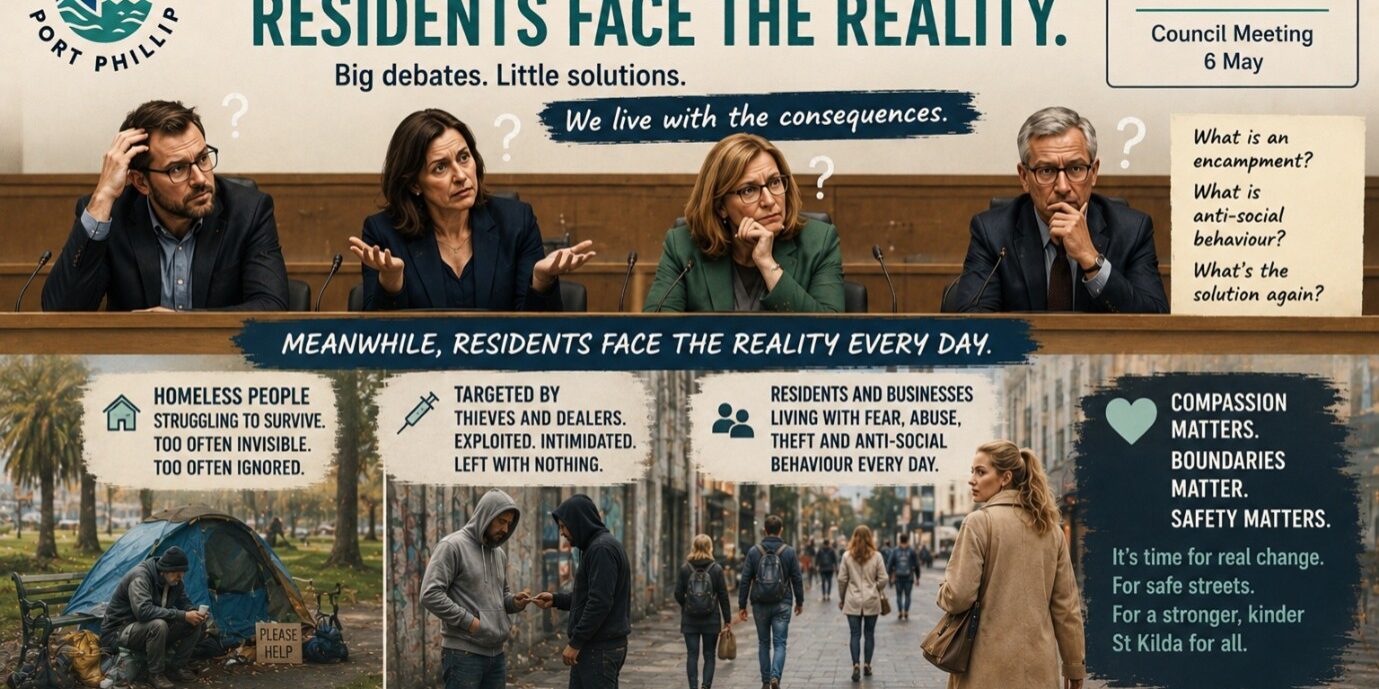
Councillors vote for new encampment local laws that target antisocial behaviour not homelessness
The Proposed Local Law Amendment was carried at the City of Port Phillip Council meeting on 6 May, voted for by Mayor Makin, Deputy Mayor Mears and Councillors Jay, Hardy and Thomann.
Voting against were Councillors Buckingham, Crawford and Halliday, while Councillor Cunsolo abstained.
What is the new encampment local law?
Council has voted to change Local Laws to help manage antisocial behaviours linked to encampments that reduce community safety or amenity. The change gives local law officers and police powers to respond when camps are creating risks to community safety or significant amenity impacts in public spaces. Authorised officers will be able to:
- Ask someone to remove encampment equipment
- Remove the equipment if the person does not comply
- Impound the equipment when needed
Importantly, the new local law is designed to maintain a welfare‑first approach for people experiencing homelessness. Council will continue to partner with local health and welfare services to help people move into safe, long‑term housing, provide mental health, alcohol and drug support and maintain a ‘By Name List’ of rough sleeper.
Will people be fined?
No. The amendment does not introduce fines. Enforcement focuses only on removing or impounding equipment when necessary.
What unfolded throughout the evening was less a robust and practical debate about community safety and public amenity, and more an exercise in emotional politics, heartstring pulling and, at times, complete detachment from the reality many residents, traders and volunteers experience daily in St Kilda.
By 9pm, many in the chamber looked exhausted. Frankly, most of us are fatigued by this issue.
Another major frustration was the so-called “community consultation” process. While local resident Rod (St Kilda) highlighted consultation outcomes during his 2 minutes in the chamber and prior to the debate, many residents walked away feeling the process failed to genuinely capture the voice of the local community most affected.
Around 23% of respondents were reportedly from outside the City of Port Phillip, while activist networks rapidly mobilised online to influence the discussion. Meanwhile, many actual residents, traders and ratepayers living with these issues daily were never directly contacted through targeted resident or rates databases.
By comparison, the “Safer Streets” petition gathered more than 2,357 signatures through genuine grassroots engagement at local markets and shopping strips across St Kilda, Elwood, Albert Park and Middle Park — yet many felt those voices were downplayed during the debate.
Residents are not asking for cruelty. They are asking to feel heard, safe and supported in their own neighbourhoods.
A huge thank you must go to Russell, our much-loved local pharmacist, and Charlotte, who once again spoke passionately and honestly about what is happening on the ground. Charlotte has spoken so many times on these matters she probably feels like a broken record — but the reality is residents and traders have been repeating the same concerns for years.
Missing from the chamber at this important debate were Nina Taylor MP for Albert Park and Josh Burns MP, Special Envoy for Social Housing and Homelessness. Considering their electorates and portfolios sit at the centre of many of these issues, their absence was disappointing.
The crowd itself reflected how divided the issue has become. Many opponents of the motion spoke about the lived experience of people experiencing homelessness and raised fears that Local Laws would “steal” personal belongings. Council officers rightly and firmly rejected that claim because it is simply not true. Residents see unattended property left across public spaces daily for extended periods of time. Council also has processes in place to allow personal belongings to be retrieved where required.
What many opponents failed to acknowledge, however, was the fundamental issue residents and traders continue to face — drug encampments, anti-social behaviour, intimidation, theft, violence and serious safety concerns that are impacting permanent residents, workers and vulnerable community members alike.
The meeting became bogged down in endless semantic debates: “What is an encampment?”, “What defines anti-social behaviour?” and “How many complaints justify action?” Meanwhile, people living and working in the hotspots know exactly what the reality looks like because they experience it firsthand.
Council officers remained patient, pragmatic and realistic throughout the debate. Even the CEO politely indicated that Councillors had been provided with the information and tools needed to make a decision.
The broader reality is this: the State Government is failing on housing supply, drug harm reduction and frontline policing resources. Council is not responsible for housing people. Residents already pay enormous taxes, while skyrocketing land tax increases have directly contributed to rising rents and cost-of-living pressures.
At the same time, police resources are stretched thin and residents are increasingly frustrated that despite endless roundtables, workshops and consultations, there has been little visible improvement on the streets. In fact, many locals would argue the situation has escalated in the last few months.
As members of Grimestoppers, a small volunteer group of women passionate about cleaning graffiti, rubbish and overflowing bins while trying to restore some pride in our eclectic community, we see these conditions daily.
This motion will not magically solve the problem overnight, and yes, original motion to remove camping exemptions was watered down. But continuing to do nothing was not an option.
Residents can still support vulnerable people compassionately while also expecting boundaries, accountability and safe public spaces. The two are not mutually exclusive.
- If you see anti-social behaviour, report it to the police.
- If you see dumped rubbish or abandoned encampments, report it through Snap Send Solve.
And if you genuinely care about people sleeping rough, support organisations making a practical difference on the ground, including Christ Church St Kilda, Sacred Heart Mission and St Kilda Gatehouse.
Compassion matters. But so does community safety, accountability and the right for residents, businesses and vulnerable people alike to feel safe in one of the world’s supposedly most liveable cities.
Port Phillip Matters
Our local Port Phillip Matters newspaper keeps you up to date on community sports, school events, local personalities, local pets, with real community spirit.
Recent Comments